- No admission allowed
- permanently closed
Löher Mill (Löhrmühle)
Industrial Heritage
The mill in the Ennepe Valley may have existed as early as the 15th century. It was first mentioned in 1552, when the St. Gereon Foundation in Cologne leased it to Dietherich von Halverscheid. Originally known as the Eichhofer Mill, it received its current name in 1811. In 1589, the mill passed from ecclesiastical ownership to noble ownership, first to the Knights of Edelkirchen, then to Baron von Holtzbrinck of Altena, in whose family it remained for approximately 170 years.


Address
Löher Mill (Löhrmühle)
Löhrmühle 2
58553 Halver
Telephone: 02353/5115
Properties:
The Löher Mill was not a compulsory mill, where local farmers were forced to have their grain ground only there, but rather a private mill that many farmers chose to use voluntarily. In the first half of the 18th century, it served about 500 farmers from the villages of Eichhofen, Glörfeld, and Öckinghausen. It was thus one of the medium-sized private mills, but suffered significant losses over the decades: By 1800, only 115 farmers were still bringing their grain to be milled.
One reason for this decline was that the millhands—most of whom were unskilled—were unable to remedy technical defects, while the tenants were interested only in economic profit and not in maintaining the building or the milling machinery. Consequently, the mill stood idle for years toward the end of the 18th century due to its dilapidated condition. In 1805, it was therefore extensively renovated and took on its current form. In 1811, Ludwig von Holtzbrinck sold the farm and mill to Johann Hermann Neuhaus, whose family operated the mill for another 160 years. The last miller was Eduard Neuhaus, who sold the farm and mill in 1952 to his long-time tenant, Otto Fischer, and kept the building in good condition well into the 1970s.
The mill remained in operation and was thus preserved in working condition. The mill is powered by water from the Ennepe River. About 250 meters upstream from the building, the Obergraben canal branches off from the Ennepe and supplies water to the mill as needed. Over the last twenty meters, the Obergraben narrows into a narrow, deep channel. The water then flows through a pipe and drives the mill’s overshot wheel. The power is transmitted from the water wheel to the millstones via gears. At the same time, a cam ring rotates, driving the “shaker shoe” via a wooden rod. This allows the grain to trickle in a steady stream through the opening in the runner stone, where it enters between the millstones and is crushed. It then falls through the flour chute into the collection sack suspended in the basement. The milling fee (multer) was generally 4 percent of the grain delivered, so considerable quantities of flour and grain accumulated in the mill building.
A bakery was therefore set up on the neighboring farm. Bread and baked goods were transported by horse-drawn cart and sold in the surrounding villages. During the 1980s, the mill was restored with the assistance of the city of Halver, the Märkischer Kreis, and the Westphalian Office for the Preservation of Historical Monuments. The original rubble stone masonry was exposed, the upper moat was secured with a retaining wall, and one of the two grinding mechanisms was restored to working order, so that rye groats for whole-grain bread can be ground again at any time.
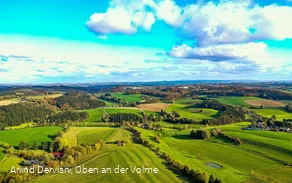
Incidentally, you can discover the Löhrmühle on the “VolmeSchatz – Panorama: Märkische Fernsichten” themed hiking trail, which begins and ends at the Nordeler Schleifkotten hiking parking lot near the mill.
All information is provided without guarantee!
Directions
On the Kuhlen